
Have you ever paused while typing and wondered how to spell kitchen correctly? Even though it is a common word used in everyday conversation, many people still hesitate for a moment before writing it. The combination of the letters “t,” “c,” and “h” often causes confusion, leading to common misspellings like “kichen” or “keetchen.”
In this ultimate 2026 guide, we will explain how to spell kitchen, why the word includes a silent letter, its historical origin, and how children can learn to spell it easily.
Quick Answer: How Do You Spell Kitchen Correctly?
The correct spelling of the word is: K-I-T-C-H-E-N.
The word contains seven letters and consists of two syllables: kitch-en. Many people accidentally spell it incorrectly because the letter “t” is silent when combined with “ch,” making it easy to overlook.
- Correct spelling: Kitchen
- Common incorrect spellings: Kichen, Kittchen, Keetchen, Kitchin
Why Is There a “T” in Kitchen? Understanding the Rules
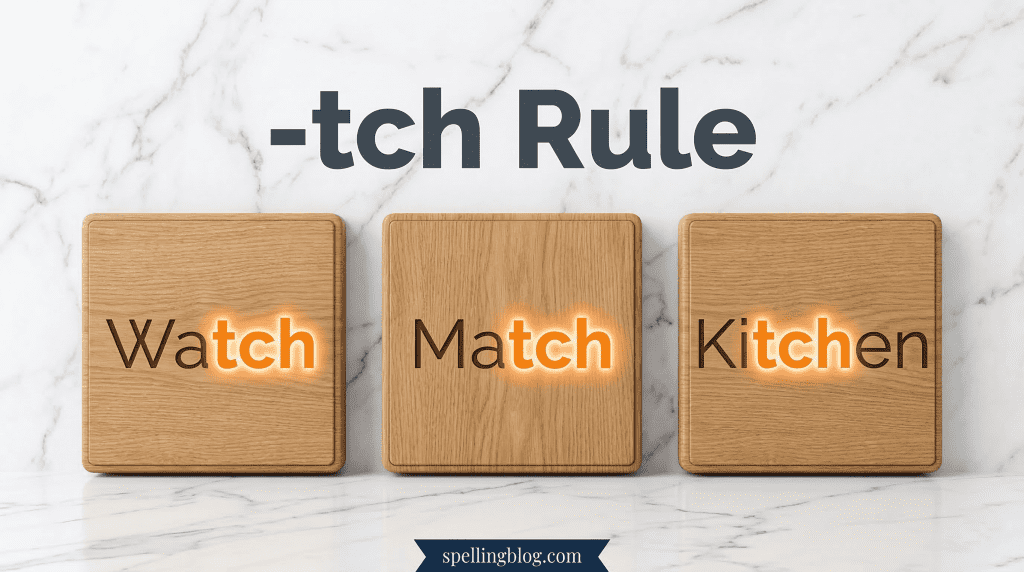
One of the main reasons people struggle with how to spell kitchen is the silent “t.” In English spelling, when a short vowel sound (like the “i” in kitchen) appears before the “ch” sound, it is almost always spelled using the trigraph -tch.
Examples of the -tch Rule:
- Watch (follows the short “a” sound)
- Match (follows the short “a” sound)
- Pitch (follows the short “i” sound)
The word kitchen follows this exact phonetic pattern. Even though the “t” is not strongly pronounced, it is a structural necessity in English orthography. If you master this rule, you will never struggle with how to spell kitchen again.
How Children Learn to Spell Kitchen
Teaching children how to spell kitchen requires breaking the word down into manageable chunks. Educators often use the following strategies:
- Phonemic Awareness: Teachers encourage kids to listen for the “ch” sound. They explain that in the “tch” family, the “t” is a “ghost letter.”
- Syllable Clipping: By clapping out the syllables (KITCH-EN), children learn to visualize the word in two parts.
- The “Kitchen Table” Association: This is a famous mnemonic. “Every Kitchen has a Table.” This helps kids remember that the word starts with K (not C) and includes a T.
Kitchen Spelling in Other Languages
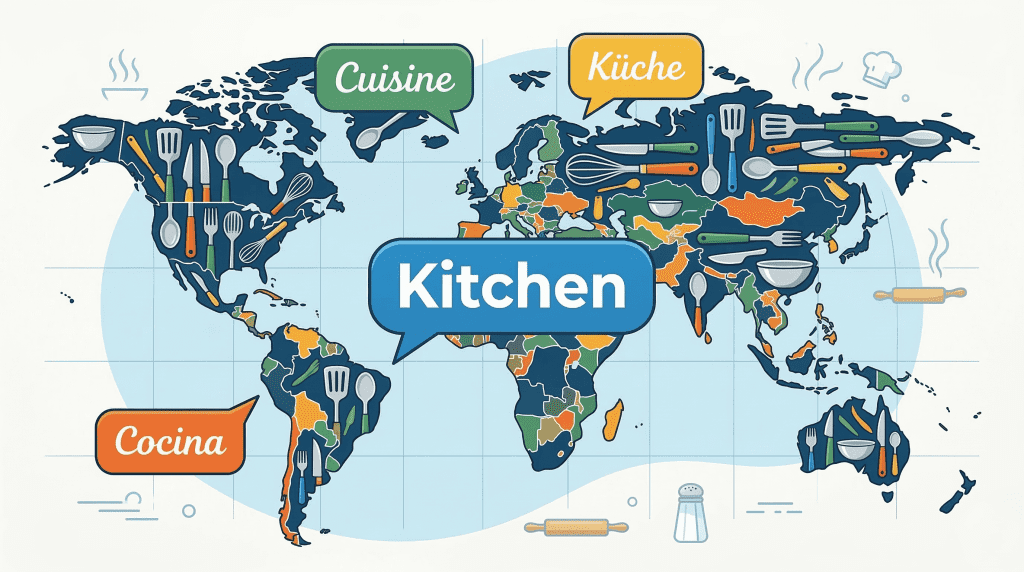
Understanding how other languages spell this word can help you appreciate why how to spell kitchen in English is so unique. While the spelling changes, the root often remains similar:
| Language | Spelling | Pronunciation |
| German | Küche | Koo-shuh |
| French | Cuisine | Kwee-zeen |
| Spanish | Cocina | Ko-see-nah |
| Italian | Cucina | Koo-chee-nah |
| Dutch | Keuken | Kuh-ken |
Notice how the French “Cuisine” and Italian “Cucina” look similar to the Latin root coquina.
Kitchen vs. Kitchin: Is it a Surname?
A common point of confusion when learning how to spell kitchen is the variation “Kitchin.” While “Kitchen” refers to the room, Kitchin is actually a legitimate English surname.
- Kitchen: The cooking area.
- Kitchin: A variant of the surname “Kitchener” or “Kitchin.”
If you are researching genealogy, “Kitchin” might be correct. However, for household context, always use Kitchen.
The Origin and History of the Word Kitchen
The history of the word dates back centuries. The English word evolved from the Old English “cycene.” The root can be traced even further back to the Late Latin word “coquina,” meaning a place where food is cooked. As the word passed through German and Old English influences, the silent “t” was eventually added to stabilize the short vowel pronunciation. This historical context explains the complexity of how to spell kitchen in modern English.
Tips and Tricks to Remember the Spelling
If you often forget the silent “t” when thinking about how to spell kitchen, use these tricks:
- Break it down: Kitch + en.
- Rhyme Time: It rhymes with pitch and hitch.
- Visual Memory: Look at the word as K-I-T (like a tool kit) + C-H-E-N. You keep your cooking kit in the kitchen!
“Mastering the spelling of household words is the first step toward professional writing. If you enjoy learning the secrets behind famous kitchen-related terms, you should read our deep dive into [Who is Bigfoot in Kitchen Confidential?].”
Common Misspellings Table
| Correct Spelling | Common Error | Why it’s Wrong |
| Kitchen | Kichen | Missing the silent “t” required after short vowels. |
| Kitchen | Kittchen | Only one “t” is needed in the -tch trigraph. |
| Kitchen | Keetchen | Uses the “ee” sound instead of the short “i”. |
| Kitchen | Kitchenn | English words rarely end in a double “n”. |
For more community debates on the spelling variations of this word, you can check out this [Kitchen vs Kitchin discussion on WordReference].
Frequently Asked Questions (FAQ)
1. How do you spell kitchen phonetically?
A: Phonetically, it is written as /ˈkɪtʃ.ən/.
2. Why do people misspell kitchen?
A: Most mistakes occur because the “t” is not pronounced and people rely purely on phonetic spelling rather than the -tch rule.
3. Is there a difference between a kitchen and a kitchenette?
A: Yes. A kitchen is a full-sized room, while a kitchenette is a small cooking area. Note that kitchenette also follows the same rules on how to spell kitchen.
4. When should I use “Kitchin”?
A: Only use “Kitchin” if you are referring to the specific surname.
Conclusion
Mastering how to spell kitchen is a milestone in English literacy. By understanding the -tch rule, remembering the “Table” mnemonic, and knowing its Latin roots, you can write this word with 100% accuracy. Now that you’ve finished this guide, you should be an expert on how to spell kitchen!